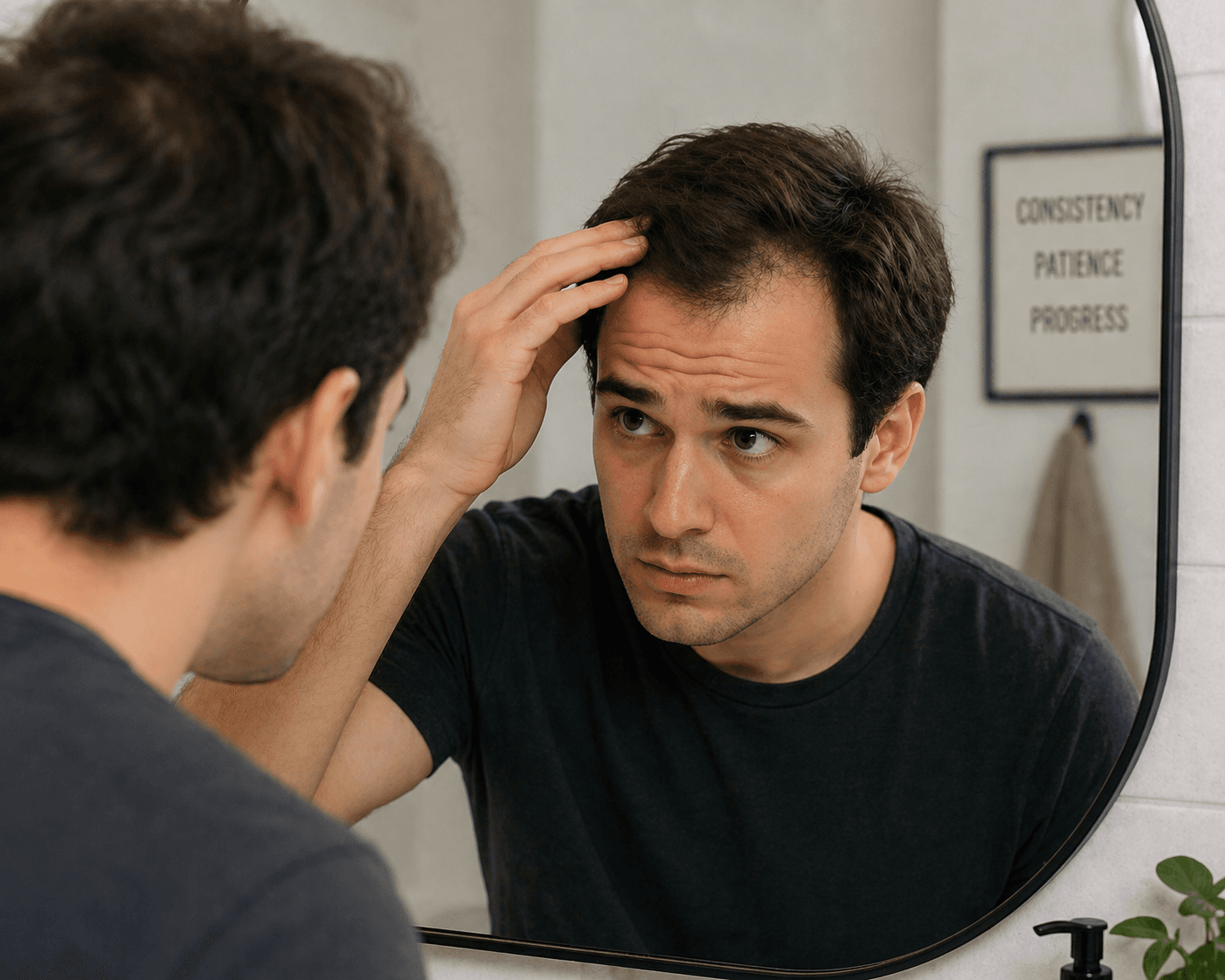



Searches for finasteride Canada mostly turn up forum threads. One says it saved someone’s hairline. The next says it ruined someone’s life. Neither is a useful basis for a decision. Here is what the trial data actually shows, including the side effect numbers most articles skip.
Key takeaways
- Finasteride is a prescription-only 5-alpha reductase inhibitor in Canada. It lowers dihydrotestosterone (DHT), the hormone that shrinks hair follicles in androgenetic alopecia.
- In the pivotal two-year trials, daily finasteride 1 mg increased hair counts and slowed further loss, while the placebo group kept losing hair.
- In those same trials, roughly 1.8% of people reported decreased libido and 1.3% reported erectile dysfunction, compared with 1.3% and 0.7% on placebo.
- The Canadian product monograph also lists mood changes, depression, and sexual side effects that continued after stopping. These are uncommon but they are documented.
- It works while you take it. Stop, and DHT returns to baseline within weeks.

What finasteride actually does
Androgenetic alopecia is not really about how much testosterone you have. It is about what your scalp does with it.
An enzyme called type II 5-alpha reductase converts testosterone into dihydrotestosterone. In people genetically sensitive to DHT, that hormone slowly miniaturizes hair follicles on the scalp. Each growth cycle produces a thinner, shorter, less pigmented hair, until the follicle stops producing a visible hair at all.
Finasteride blocks that enzyme. Less conversion means less scalp DHT. This means the shrinking process slows down and some already-shrunken follicles can recover.
Two things follow from this mechanism. They explain most of what people find confusing about the drug.
First, it is preventive before it is restorative. Slowing loss is the main effect. Regrowth is a secondary benefit, and plenty of people see little of it.
Second, the effect depends on continuous use. The enzyme is only blocked while the medication is in your system. There is no lasting change to the follicle once treatment stops.
Finasteride Canada: prescription status, doses, and formats
Finasteride needs a prescription in Canada. Health Canada has authorized it in two oral strengths. They are not swappable.
| Format | Strength | What it is authorized for |
|---|---|---|
| Oral tablet | 1 mg daily | Androgenetic alopecia in adult males |
| Oral tablet | 5 mg daily | Benign prostatic hyperplasia |
| Topical solution or foam | Compounded, commonly 0.25% | Not a Health Canada authorized product. Prepared by a pharmacy against a prescription. |
People often ask about finasteride 5mg for hair. The 5 mg tablet was authorized for prostate enlargement, not scalp hair. The dose-ranging research found no meaningful added hair benefit above 1 mg. Higher dose does not mean better outcome here. It mostly means more systemic exposure.
Generic 1 mg finasteride from several Canadian manufacturers has been available for years. That is why the cost has dropped much from the original brand price.
Topical finasteride is a different situation. It is not an authorized Health Canada product, so it is compounded by a pharmacy. The rationale is lower systemic absorption, and the early data on serum DHT reduction supports that. The human evidence base is much smaller than for the oral tablet. That difference matters when you are weighing it up.
What the research actually shows
This is where the forum threads and the evidence diverge most.
The pivotal work is a pair of one-year randomized trials involving 1,553 men aged 18 to 41, with 1,215 continuing into a second blinded year. In a defined 5.1 cm² patch of vertex scalp with a baseline count of 876 hairs, the finasteride group gained 107 hairs relative to placebo at one year and 138 at two years. The placebo group lost hair slowly over the same period.
A later systematic review in JAMA Dermatology pooled the available trials and graded the evidence as moderate quality. It found a mean increase in hair count of about 9.4% over placebo in the short term and about 24.3% in the longer term. The same review concluded that finasteride increases the risk of sexual dysfunction. Both findings came from the same analysis, and an honest summary has to carry both.
A separate phototrichogram study of 212 men found that the effect comes largely from pushing follicles back into the growth phase. Anagen hair counts rose 26% over placebo at 48 weeks.
What this does not tell you: how any individual will respond. Trial averages describe groups. Response varies, and some people see very little.
The side effect conversation, with the actual numbers
Most of what people read about finasteride side effects online comes from self-selected reports. The controlled data looks different, and the honest position is that both sources are telling you something real.
From the Canadian product monograph, first-year drug-related adverse events in the 1 mg hair loss trials:
| Effect | Finasteride 1 mg (n=945) | Placebo (n=934) |
|---|---|---|
| Decreased libido | 1.8% | 1.3% |
| Erectile dysfunction | 1.3% | 0.7% |
| Ejaculation disorder | 1.2% | 0.7% |
| Decreased ejaculate volume | 0.8% | 0.4% |
Discontinuation because of a drug-related adverse experience occurred in 1.7% of the finasteride group and 2.1% of the placebo group.
Two things about that table deserve attention. The absolute rates are low. And the placebo rates are not zero. That means a portion of reported symptoms in any group are not caused by the drug.
That is not the whole picture. The Canadian monograph separately lists post-marketing reports of sexual dysfunction that continued after stopping, breast tenderness and enlargement, testicular pain, reduced semen quality, and mood alterations including depressed mood and, less often, suicidal ideation. Frequency for these is not established. That means they are considered uncommon but cannot be quantified from the trial data. Health Canada added persistent sexual side effects to the Canadian labelling in late 2011.
If you experience mood changes, low mood, or thoughts of self-harm while taking finasteride, stop and contact a healthcare provider.
Anyone who is pregnant or may become pregnant should not handle crushed or broken finasteride tablets. The medication can affect development of the external genitalia in a male fetus.
Finasteride also lowers PSA readings, which matters if you are being screened for prostate concerns. Tell the clinician ordering that test that you take it.
Combining finasteride and minoxidil
The finasteride minoxidil combination is common because the two work on completely different parts of the problem.
Finasteride addresses the hormonal driver by reducing DHT. Minoxidil acts at the follicle itself, extending the growth phase and increasing blood flow to the area. Neither replaces the other, and using both is a standard approach in clinical practice rather than an exotic one.
Practical notes worth knowing before you start either. Minoxidil commonly causes a temporary increase in shedding in the first several weeks as follicles synchronize into a new cycle. That phase is expected and is not a sign of failure. Both treatments need six to twelve months of consistent use before you can fairly judge the result, and photographs taken under the same lighting are a far better assessment tool than a daily mirror check.
Safety and who should speak to a healthcare provider first
Speak with a licensed healthcare provider before starting if any of the following apply to you:
- You are pregnant, may become pregnant, or are breastfeeding
- You have a history of depression, anxiety, or other mental health conditions
- You have liver disease or reduced liver function
- You have a personal or family history of breast cancer
- You are planning to conceive in the near term, or are being assessed for fertility
- You are due for prostate screening or have known prostate concerns
- Your hair loss started suddenly, came out in patches, or came with scalp pain, scaling, or scarring
That last one matters more than people assume. Sudden or patchy loss is usually not androgenetic alopecia, and treating it as though it is delays the correct diagnosis.
 Frequently asked questions
Do you need a prescription for finasteride in Canada?
Yes. Finasteride is a prescription-only medication in Canada in every format, including compounded topical preparations. A licensed prescriber has to assess you before it can be dispensed. That assessment can be completed online with MyRocky, which is LegitScript-certified and licensed as a Canadian pharmacy. Most people now start there rather than booking an in-person appointment.
How long does finasteride take to work?
Early changes in hair counts have been measured as soon as three months. But visible change usually takes longer. Most clinicians assess the result at six months and reassess at twelve. Judging it before six months will mislead you in both directions.
Can you take finasteride 5mg for hair loss?
The 5 mg strength was authorized for benign prostatic hyperplasia, not for scalp hair. Dose-ranging research found 1 mg was the effective dose for androgenetic alopecia, with no meaningful added benefit at 5 mg. Splitting 5 mg tablets is not a clinician-directed approach.
What happens if you stop taking finasteride?
Scalp DHT returns to pre-treatment levels within weeks of stopping. Hair gained during treatment is usually lost over the following several months. The underlying pattern resumes from there. The medication pauses the process rather than ending it. That is a consequence of the mechanism, not a sign the treatment failed.
Does finasteride work on a receding hairline?
The frontal scalp was studied separately from the vertex in the trial programme and showed improvement. That said, the effect at the vertex has usually been the more consistent finding across studies. Response at the temples specifically varies more between people. So a receding hairline is less predictable than crown thinning.
Are finasteride side effects permanent?
In controlled trials, reported sexual side effects resolved in most people who stopped taking it. The Canadian product monograph does separately list post-marketing reports of symptoms continuing after stopping, with frequency not established. That means the risk is real and documented, but cannot be quantified from trial data. It is a low risk, not a zero one.
The bottom line
Finasteride has two decades of controlled trial data behind it. That data shows a consistent effect on hair counts, alongside a small but real increase in sexual and mood-related side effects, and both halves come from the same evidence. Whether the trade is worth it is a decision to make with a clinician who knows your history, not with a forum thread.
To work out what fits your situation, see MyRocky’s prescription finasteride options or look at how finasteride and minoxidil are used together. You can also start an online assessment with a licensed Canadian prescriber.
References
- Kaufman KD, Olsen EA, Whiting D, et al. Finasteride in the treatment of men with androgenetic alopecia. Journal of the American Academy of Dermatology, 1998. https://pubmed.ncbi.nlm.nih.gov/9777765/
- Mella JM, Perret MC, Manzotti M, et al. Efficacy and safety of finasteride therapy for androgenetic alopecia: a systematic review. JAMA Dermatology, 2010. https://jamanetwork.com/journals/DERM/articlepdf/422032/dev05002_1141_1150.pdf
- Health Canada Drug and Health Product Register. Finasteride tablets 1 mg product monograph. https://pdf.hres.ca/dpd_pm/00078397.PDF
Disclaimer: This article is intended for informational purposes only and is not a substitute for professional medical advice, diagnosis, or treatment. Always consult your healthcare provider with any questions about a medical condition or treatment.
Editorial Standards: At Rocky Health, we’ve made it our mission to support men and women with trustworthy, easy-to-understand medical and health information online. Read more about our editorial standards here.